
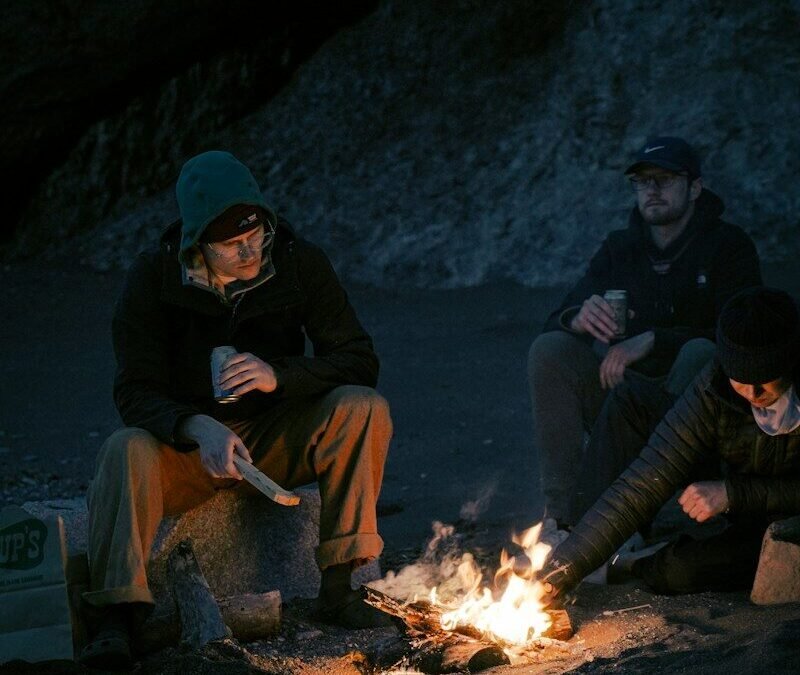
We were sitting at a fire, and nobody was talking. We both knew there was hardship there, and neither of us was saying anything about it. Then, with tears streaming down his face, all the weight he had been carrying opened up and came out.
Nobody had asked him how he was doing. Nobody had turned to face him and asked him to talk. We were sitting shoulder to shoulder, looking at the same fire, and that turned out to be enough.
Looking at the same thing takes the spotlight off the person. Nobody is reading your face. You can stop in the middle of a sentence, and the silence belongs to the fire instead of to you. The same is true on a trail, in a truck, or standing next to a pair of motorcycles at a gas station.
Geoffrey Greif, a University of Maryland professor who interviewed hundreds of men for his book Buddy System, described male friendship as shoulder to shoulder rather than face to face. Men tend to build friendships doing something next to each other, not sitting across from each other talking about it. AARP’s study of men and friendship this year put it plainly. “The data shows men lean toward ‘doing’ over ‘talking,'” said Jordan Green of AARP Research.
And the friendships are thinning. The Survey Center on American Life found that 12 percent of Americans had no close friends at all in 2021, up from 3 percent in 1990.
None of that means men don’t talk. It means most of us need somewhere else to look before we will.
It lands hardest on men whose work runs on composure. Cops, firefighters, surgeons, and the guy running a plant with a few hundred people counting on him all get trained the same way. The job teaches you to keep your face still. Asking that same man to sit across from someone and let his face move is asking him to do the one thing he has practiced not doing.
Most of what we offer a man who is struggling is face to face: an office with the door closed, or a supervisor asking “how are you holding up?” across a desk. Those have their place, and this doesn’t replace a counselor or a peer support team when a man needs one. Sometimes the side-by-side is what gets him there. But for a lot of men, being looked at is the hardest part of being helped.
It doesn’t always happen. I co-founded Frontline Freedom, which takes first responders into the backcountry, and it started because I needed it myself. The honest answer to what happens out there is that sometimes nothing does.
Healing operates at the speed of trust. Yes, this is a play on words from Gen Mattis’ book Call Sign Chaos, in which he quips, “operations move at the speed of trust.”
When men trust each other, the vulnerability shows up on its own schedule. You can’t book it. You can only keep sitting next to someone until it’s safe.
Some of that I’ve done on purpose. I have kept a healthy group of friends my whole life, men I’m comfortable being vulnerable with. I met them in neighborhoods, at hockey rinks, at work, and on trails. And somewhere along the way I made a deliberate choice to focus those friendships on people outside policing, so promotions and work politics couldn’t ruin them.
There’s a strong pull in this work to make the job your whole circle. I’ve resisted it on purpose, and I’d tell any young officer to do the same. Keep your brothers at work. Just don’t let them be the only friends you have, because the job decides who you sit next to, and the job will change its mind.
That choice can sound cold until you’ve been promoted a few times. Rank changes the side-by-side. The guy you used to work next to now works for you, and both of you know it, and the fire gets harder to sit at. Every leader eventually finds out that the job’s friendships run on the job, and the job keeps changing. The higher you go, the fewer people can sit next to you without the rank sitting there too. A leader whose only friends are work friends can lose most of them to a single promotion.
A lot of what I’ve shared about my own life, I’ve shared at the back of a gas station somewhere in the Midwest, in the middle of a long ride. It isn’t a place anybody would pick for an honest conversation. That’s probably why it works.
C.S. Lewis wrote in The Four Loves: “Lovers are normally face to face, absorbed in each other; Friends, side by side, absorbed in some common interest.” He published that in 1960. Sixty-some years later, we’re still trying to get men to talk face to face, and most of them are still waiting for something to do with their hands.
Lewis’s point was that friends are defined by what they’re looking at together. Take the common interest away and a lot of male friendships go quiet, which is why so many men lose their friends when the team, the unit, or the job ends. The friendship was real. It just never learned to live anywhere else.
So stop waiting for the right conversation, and plan the right activity.
Pick one man you’ve drifted from. If you lead people, make it someone outside your chain of command, someone a promotion can’t touch. Then put something side by side on the calendar, a ride or a long hike or a project in his garage, and go. It doesn’t have to be a motorcycle or a mountain. Helping a man move a couch counts. Don’t announce that you want to talk. Don’t steer it toward anything. Just go, and then go again.
Trust gets built in reps. The first ride is about the ride. By the third or fourth there’s some history, a stretch of road you both remember, and that’s the ground the hard conversation stands on when it finally comes.
If you’re the one carrying something, you can make the invitation yourself. You don’t have to say why. “Want to ride Saturday?” is a complete sentence, and it’s a lot easier to say than “I’m not doing well.”
The same thing holds at work. If you lead people, try the check-in somewhere other than across your desk: in the car, on a walk, working the detail next to them. Ask your question while you’re both looking at something else, and then let the silence sit for a while before you fill it. A lot of men will answer the second question, or the third, or the one they bring up themselves twenty minutes later.
And when it does open up, at a fire or a gas station or in the front seat of a car, your part gets small. Stay where you are. Don’t turn to face him. Don’t reach for advice or a fix. Let him finish, and let the silences sit. The side-by-side is what made it possible, and the fastest way to close it back up is to turn it into a conversation about what he should do next.
The fire didn’t do anything that night but give a man somewhere to look while it came out.
Plan the ride. Let the gas station do the rest.
- C.S. Lewis, The Four Loves (1960).
- Geoffrey Greif, Buddy System: Understanding Male Friendships, as described in Psychology Today, Jarie Bolander, “How the In-Between Helps Men Make Friends,” March 13, 2026. https://www.psychologytoday.com/us/blog/the-male-friendship-experience/202603/how-the-in-between-helps-men-make-friends
- AARP, study on Gen X men and friendship, March 6, 2026. https://www.aarp.org/family-relationships/gen-x-men-friendship-study/
- Daniel A. Cox, “The State of American Friendship: Change, Challenges, and Loss,” Survey Center on American Life, June 8, 2021. https://www.americansurveycenter.org/research/the-state-of-american-friendship-change-challenges-and-loss/